



























-
Last week we held our Orientation and Lunch Party for the iFest|TechShop Game Design Challenge. Thanks to everyone for coming out and sharing your ideas! Please see the information below for updates about the Challenge and the Request for Proposal (RFP).
About the iFest|TechShop Game Design ChallengeThe TechShop of Pittsburgh and the University of Pittsburgh’s School of Information Sciences (iSchool) invite you to participate in the iFest|TechShop Game Design Challenge. The challenge: work in teams of three to design and develop an interactive game. As part of the challenge, student teams are required to submit a proposal detailing their game idea and concept. Three student teams will be selected, based on their proposals, to develop working prototypes of their games using the tools and services at TechShop. Those three teams will present their game prototypes at iFest 2015 (Feb. 6).
The team judged to have designed and developed the best game concept and prototype will win a prize of $500 per person.
Proposal Requirements
- Propose a new game concept or significantly improve/modify an existing game
- Proposed game must have a narrative or back-story
- Proposed game must have robotics/physical computing components powered by either Arduino or Hummingbird kits
- Final prototype must be fabricated and work within the described parameters of the game
Proposals must be submitted by: October 10, 2014
Follow this link for the full RFP.
Advising & Support Workshops
iSchool staff and faculty will be available to answer questions and provide advising to teams during the dates/times listed below. Drop by any of these workshops to brainstorm game ideas and concepts, learn how to use Arduino and Hummingbird kits, and get feedback on your proposals. For additional support from staff and faculty, see the attached RFP.
Proposal Advising & Introduction to Arduino Kits
Friday, September 19: 2:30PM – 4:00PMProposal Advising & Introduction to Hummingbird Kits
Friday, September 26: 2:30PM – 4:00PMProposal Advising
Friday, October 3: 2:30PM – 4:00PM
All advising and support workshops will be held on the 3rd floor.
Registration Form
If you are interested in participating, please complete the registration form. Please indicate whether or not you have already formed a team to participate in the Game Design Challenge. If you do not have a team, complete the form and we will help you find other students interested in forming a team. If you already have formed a team, all members of your team must complete a separate registration form.
-
When I worked for the School of Medicine, I worked quite a bit with medical doctors and educators are experts on medical education and medical simulations. Over the years I’ve seen many simulators, ranging from simple text-based scenarios (kind of like the Hitchhiker’s Guide to the Galaxy game to elaborate simulations taking place in Second Life to the extremely expensive (and extremely creepy) mannequin simulators.
The one thing that struck me about the mannequin simulators is how limited they are given the price tag. The less expensive ones are barely more than plastic dolls, and the ones that attempt to emulate human physiology in its entirety are difficult to program and are very finicky.
So… I decided to see if I could build a medical simulator that costs under $300.00. Instead of trying to build the whole mannequin at once, I began to identify learning objectives for medical students and try to build individual organ simulators that would meet these objectives.
I’m currently working on an endoscopy simulator and it’s turning out to be more challenging than I ever expected. I had to learn how to build 3D models, how to manipulate and slice existing models, how to work with 3D printers, CNC routers and vacuum formers.
I first tried to build a stomach and esophagus model by 3D-printing it. However, as much as I love MakerBot Replicator printers, they can only print small items and the actual success rate is only about 60%. I cannot tell you how many times I wanted to kick a 3D printer through a wall after a 4-hour print would fail 3.5 hours into the job.


 After realizing that I could not successfully print a usable model on a MakerBot, I spoke with several people at Pittsburgh TechShop and they suggested vacuum-forming my models.


I cut a 3D model of human stomach and esophagus from high-density foam and will try to vacuum-form a prototype in a couple of week. If it works, I’ll make a more permanent mold out of MDF or wood. Once the mold is ready, I’ll break out the Arduino!
-
Many people seem to have the idea that in order to be a good programmer you have to be good at math. Let me dispel that myth for you – I have always sucked at math. My 5th grade math teacher even threw a blackboard eraser at me once in frustration when I could not get quadratic equations through my head!
That being said, when a friend of mine showed me QBasic when I was about 12, I seemed to have intuitively understood how code works. Without ever having coded before, a few hours after being introduced to QBasic I made an ASCII drawing of a car move across the screen. Since that moment I was hooked on programming.
It wasn’t until much later in life (after getting a C- in calculus) that I realized that I can learn math (and even become fairly good at it) through programming. I began to seek out books that taught subjects such as math, biology, physics and statistics though coding examples.
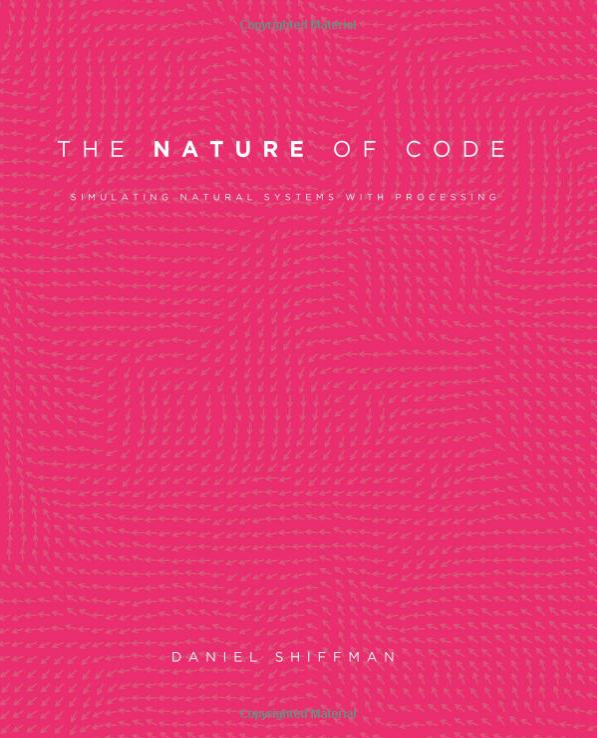
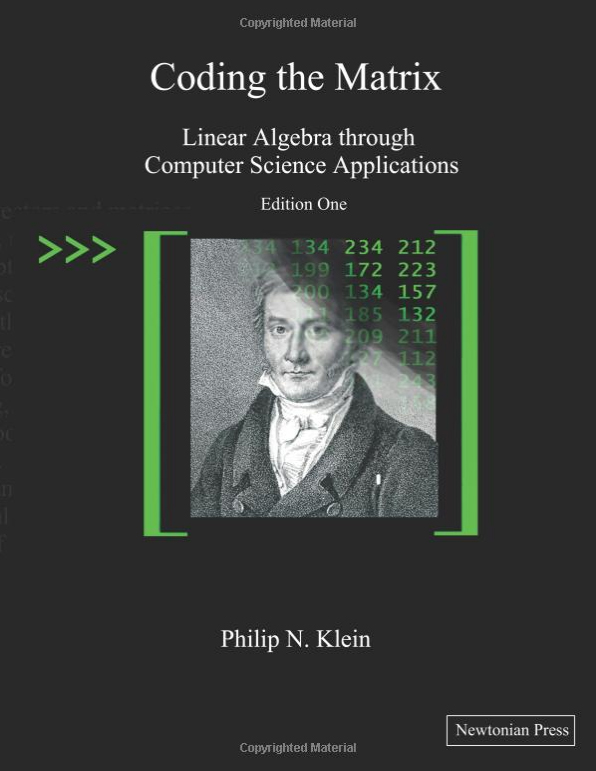
The two books I want to tell you about are The Nature of Code by Daniel Shiffman and Coding the Matrix by Philip N Klein.
The Nature of Code uses examples written in a programming language called Processing to explain natural phenomena such as randomness, cellular automata, fractals and many others. The books is extremely well written and the examples are so well commented and easy to follow that even if you don’t know Processing you should have no problems following every topic.
Coding the Matrix is a “textbook” on linear algebra that uses Python to explain the intricacies and complexities of matrices. I have not finished the entire book yet, but from what I have seen and tried so far, it is a very worthwhile addition to your bookshelf.










You must be logged in to post a comment.