Author / dmitriybabichenko
Open-Source Medical Simulator
When I worked for the School of Medicine, I worked quite a bit with medical doctors and educators are experts on medical education and medical simulations. Over the years I’ve seen many simulators, ranging from simple text-based scenarios (kind of like the Hitchhiker’s Guide to the Galaxy game to elaborate simulations taking place in Second Life to the extremely expensive (and extremely creepy) mannequin simulators.
The one thing that struck me about the mannequin simulators is how limited they are given the price tag. The less expensive ones are barely more than plastic dolls, and the ones that attempt to emulate human physiology in its entirety are difficult to program and are very finicky.
So… I decided to see if I could build a medical simulator that costs under $300.00. Instead of trying to build the whole mannequin at once, I began to identify learning objectives for medical students and try to build individual organ simulators that would meet these objectives.
I’m currently working on an endoscopy simulator and it’s turning out to be more challenging than I ever expected. I had to learn how to build 3D models, how to manipulate and slice existing models, how to work with 3D printers, CNC routers and vacuum formers.
I first tried to build a stomach and esophagus model by 3D-printing it. However, as much as I love MakerBot Replicator printers, they can only print small items and the actual success rate is only about 60%. I cannot tell you how many times I wanted to kick a 3D printer through a wall after a 4-hour print would fail 3.5 hours into the job.


 After realizing that I could not successfully print a usable model on a MakerBot, I spoke with several people at Pittsburgh TechShop and they suggested vacuum-forming my models.


I cut a 3D model of human stomach and esophagus from high-density foam and will try to vacuum-form a prototype in a couple of week. If it works, I’ll make a more permanent mold out of MDF or wood. Once the mold is ready, I’ll break out the Arduino!
Learning math through programming
Many people seem to have the idea that in order to be a good programmer you have to be good at math. Let me dispel that myth for you – I have always sucked at math. My 5th grade math teacher even threw a blackboard eraser at me once in frustration when I could not get quadratic equations through my head!
That being said, when a friend of mine showed me QBasic when I was about 12, I seemed to have intuitively understood how code works. Without ever having coded before, a few hours after being introduced to QBasic I made an ASCII drawing of a car move across the screen. Since that moment I was hooked on programming.
It wasn’t until much later in life (after getting a C- in calculus) that I realized that I can learn math (and even become fairly good at it) through programming. I began to seek out books that taught subjects such as math, biology, physics and statistics though coding examples.
The two books I want to tell you about are The Nature of Code by Daniel Shiffman and Coding the Matrix by Philip N Klein.
The Nature of Code uses examples written in a programming language called Processing to explain natural phenomena such as randomness, cellular automata, fractals and many others. The books is extremely well written and the examples are so well commented and easy to follow that even if you don’t know Processing you should have no problems following every topic.

Coding the Matrix is a “textbook” on linear algebra that uses Python to explain the intricacies and complexities of matrices. I have not finished the entire book yet, but from what I have seen and tried so far, it is a very worthwhile addition to your bookshelf.









Flower-picking with Daniella and Sophia at the Simmons Farms


Sophia getting ready for her fist day at new preschool
Sam’s Bar Mitzvah






Painting at the Mellon Park.
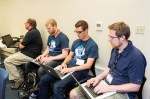
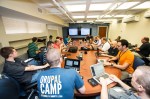
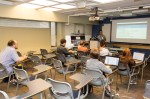
DrupalCamp PA, 2014
Last weekend the University of Pittsburgh School of Information Sciences hosted the first DrupalCampPA – a two-day conference dedicated to brining Drupal content management system to higher education & industry.
Even though I haven’t had a chance to attend many of the workshops and sessions, I was so impressed by Drupal’s capabilities (especially the ability to run Drupal headless, without its native UI), that I’m planning on doing a test deployment of Drupal for use in my classes.














More independent study projects for Fall 2014
Client: WISER Simulation Center
Project: PayPal Integration into an Existing System
Tasks: This project will involve integrating a PayPal payment system into an existing web based application. The Peter M. Winter Institute for Simulation, Education, and Research (WISER) is an institute at the University of Pittsburgh. WISER has developed a web-based application, the Simulation Information Management System (SIMS), that is used to operate the center and many other organization’s centers throughout the world.
This project will implement a PayPal subsystem to allow users to pay for courses online and either grant them access automatically to the course or alert the proper individuals that payment has been made. There will need to be a reporting back end to the system that will show administrative staff what payments have been made for what courses. There is existing infrastructure in place that utilizes other payment systems. The PayPal system is to work in parallel with those existing systems. Student /developers (S/Ds) are expected to utilizing the existing infrastructure where possible. S/Ds will work with the existing WISER development team and have the project guided by the team. The Director of Information Technology at WISER will create requirements for the system. SIMS utilizes .Net (C#) and Classic ASP VBScript for the programming component. Oracle is the underlying database. Students will need to be competent in C# and SQL, as well as HTML and JavaScript.
Successful completion of this project will enable the WISER personnel to easily integrate PayPal payments for specific courses at other centers sites.
Team Size: 1 student
______________________________________________________________
Client: WISER Simulation Center
Project: Creation of a web based data repository for simulation centers
Tasks: This project will involve creating a web-based application to allow multiple simulation centers from around the world to upload administrative metrics data into a centralized database and generate comparative statistics. The Peter M. Winter Institute for Simulation, Education, and Research (WISER) is an institute at the University of Pittsburgh. WISER works with simulation centers throughout the world. There is a need for comparative data analysis between centers. This web site will address that need.
The web application will need to allow sites to have their own users. Users can only upload data from their own site. They will need to only see individual data from their own site, while they can see aggregate data from any site in the system.
The web application will need to upload standardized Excel spreadsheets that the users will complete offline. Data will be inserted into the MySQL database from the spreadsheets.
Reporting will allow users to create what is essentially spreadsheet pivot tables from their data set to provide summarized data. There will be approximately 4-6 reports that will need to be created. Reports will need to able to be downloaded in Excel format.
Users will be able to compare the summary reports of their own center against other centers data in the system.
It is expected that PHP will be the programming language for this project and that MySQL will be the underlying database. The web site will be provided to the students.
Successful completion of this project will allow multiple sites to upload pre-defined metrics data, do comparative reports against other sites, and download summarized reports in Excel format.
Team Size: 1 student
______________________________________________________________
Client: WISER Simulation Center
Project: Develop an Implementation Plan for SCORM Integration Into an LMS
Tasks: This project will involve developing an implementation plan to allow Sharable Content Object Reference Model (SCORM) content into an existing learning Management System (LMS). The Peter M. Winter Institute for Simulation, Education, and Research (WISER) is an institute at the University of Pittsburgh. WISER has developed a web-based application, the Simulation Information Management System (SIMS), that is used to operate the center and many other organizations centers throughout the world. A subsystem of SIMS includes an LMS.
SCORM is a collection of standards for sharing educational content via the web. Many curriculum development software packages allow for the creation of SCORM objects that can then be uploaded into a SCORM compliant LMS. This provides for a diverse development environment while allowing for a broad distribution of the content over many LMS.
SIMS is internally developed at WISER and is not currently SCORM compliant. This project will involve working with the SIMS development team and creating an implementation plan for allowing SCORM content to be uploaded and integrated into the SIMS LMS. This will involve obtaining an understanding of the underlying components of SIMS, as well as an evaluation of existing open source and commercially available SCORM packages that will aid in the integration. Benefits and shortcomings of the options will be analyzed to determine the best possible course of action.
It is expected that the actual implementation of this project will take place in a later semester.
The successful completion of this project will produce a report with a viable implementation plan to integrate SCORM compliance into SIMS.
Team Size: 1 student
______________________________________________________________
Client: WISER Simulation Center
Project: Integrate a Text Notification System into an Existing System
Tasks: This project will involve integrating a text (SMS) notification system into an existing web based application. The Peter M. Winter Institute for Simulation, Education, and Research (WISER) is an institute at the University of Pittsburgh. WISER has developed a web-based application, the Simulation Information Management System (SIMS), which is used to operate the center and many other organization’s centers throughout the world.
This project will implement an existing SMS subsystem to allow users to be notified of upcoming classes and other events. This will utilize a commercially available SMS subsystem. There is existing infrastructure in place that utilizes emails for alerts and it is expected that the student /developers (S/Ds) will utilize a significant portion of that existing infrastructure. S/Ds will work with the existing WISER development team and have the project guided by the team. The Director of Information Technology at WISER will create requirements for the system. SIMS utilizes .Net (C#) and Classic ASP VBScript for the programming component. Oracle is the underlying database. Students will need to be competent in C# and SQL, as well as HTML and JavaScript.
Successful completion of this project will enable the SIMS administrators to easily integrate SMS notifications for specific courses at WISER and other centers sites.
Team Size: 1 student
______________________________________________________________
Client: University of Pittsburgh School of Business
Project: Work with business school marketing students to design a marketing campaign website for United Way
Tasks: Design a website for a United Way marketing campaign
Database: MySQL
Programming Language: PHP, HTML5, JavaScript
Frameworks: jQuery, Backbone.js
Team Size: 2 students
 Dmitriy B.
You must be logged in to post a comment.