For my 8th birthday I got a present that would shape my career aspirations for many years to come – an old beat-up Smena-8, a Soviet-made amateur 35mm rangefinder camera. For two years the camera mostly sat in my closet. I knew nothing of composition, exposure, and focusing. If a friend would load a roll of film for me, I’d bring the camera on a hiking trip or a family event. I’d click through the roll in a matter of minutes, ending up with 30+ perfectly underexposed, overexposed, or out of focus frames.
My relationship with photography changed sometime in May of 1986. On April 26, 1986, the 4th reactor of Chernobyl nuclear power station exploded, sending a giant cloud of radioactive dust all over Ukraine and Belarus. I vividly remember that day. My friends and I were playing soccer in the empty lot behind our apartment building when sudden gusts of wind drove us indoors. We thought that it was a freak windstorm and once the wind subsided, went back to play. The next morning a TV announcer mentioned in passing that a minor accident had occurred at a nuclear power plant in Pripyat and that four people had died.
Life went on as usual. We went to the International Workers’ Day parade on May 1, and to the Victory Day parade on May 9th. At some point, rumors about radioactive dust started to float around, but no one had acknowledged anything or warned us about dangers. Some people talked about eating as much seaweed as possible, but we did not know what radiation was or why seaweed would help in combating its effects. Generations of Soviet people had learned to distrust the government, so when the government repeatedly said that everything was OK, the rumor mill started churning out one horror story after another. Interestingly enough, while none of us actually knew the whole extent of the catastrophe and its possible consequences, the conspiracy theories produced by the wisdom of crowds were fairly close to the truth. At least they were fairly close to the truth when radiation was concerned.
As soon as it became clear that (a) radiation was dangerous and (b) there was a lot of it, my grandparents decided to get me as far away from Gomel as possible. In late May of 1986, my grandmother packed a suitcase for my grandfather and a backpack for me, and my grandfather and I took a taxi to the airport. Everyone who could was trying to get the hell out of dodge, so no tickets were available to go anywhere. We sat in the airport all day, waiting for “no shows” for any flight in any direction away from Belarus and Ukraine. Finally, around 11 PM, a ticket clerk waved to us and told us that two tickets had just become available for a flight to Kislovodsk, with the flight leaving in 30 minutes. My grandfather paid for the tickets, and we ran to the gates.
Kislovodsk is a spa city in the North Caucasus region of Russia, sitting somewhere between the Black and Caspian seas. Neither my grandfather nor I have ever been to Kislovodsk, we did not know anyone there, and had no plans for lodgings. Hotels in the USSR were few and far between. Generally speaking, one could not just show up and get a room. You had to have reservations, usually made by either your place of work or by someone in the government. You had to show a passport and get a temporary propiska, even if you only had to stay for one night. It was much easier to find lodgings with a local resident. Usually, it wasn’t difficult to find someone who was in need of money and had a spare room.
My grandfather and I spent our first day in Kislovodsk walking up and down its hilly streets, asking passerbys if they knew of anyone who had a room to rent. Finally, someone pointed to a small old house behind a tall wooden fence. We knocked on the gate and a disheveled kid who looked to be a year or two older than me let us in. He invited us into their kitchen and offered us tea. Eventually, maybe an hour later, the kid’s mother came home from the market. I don’t know what or how my grandfather negotiated with her, but a few minutes later she led us into a large bedroom on the second floor of the house.
The bedroom was pretty bare, with two wireframe beds, an old wooden wardrobe, and a small writing desk.
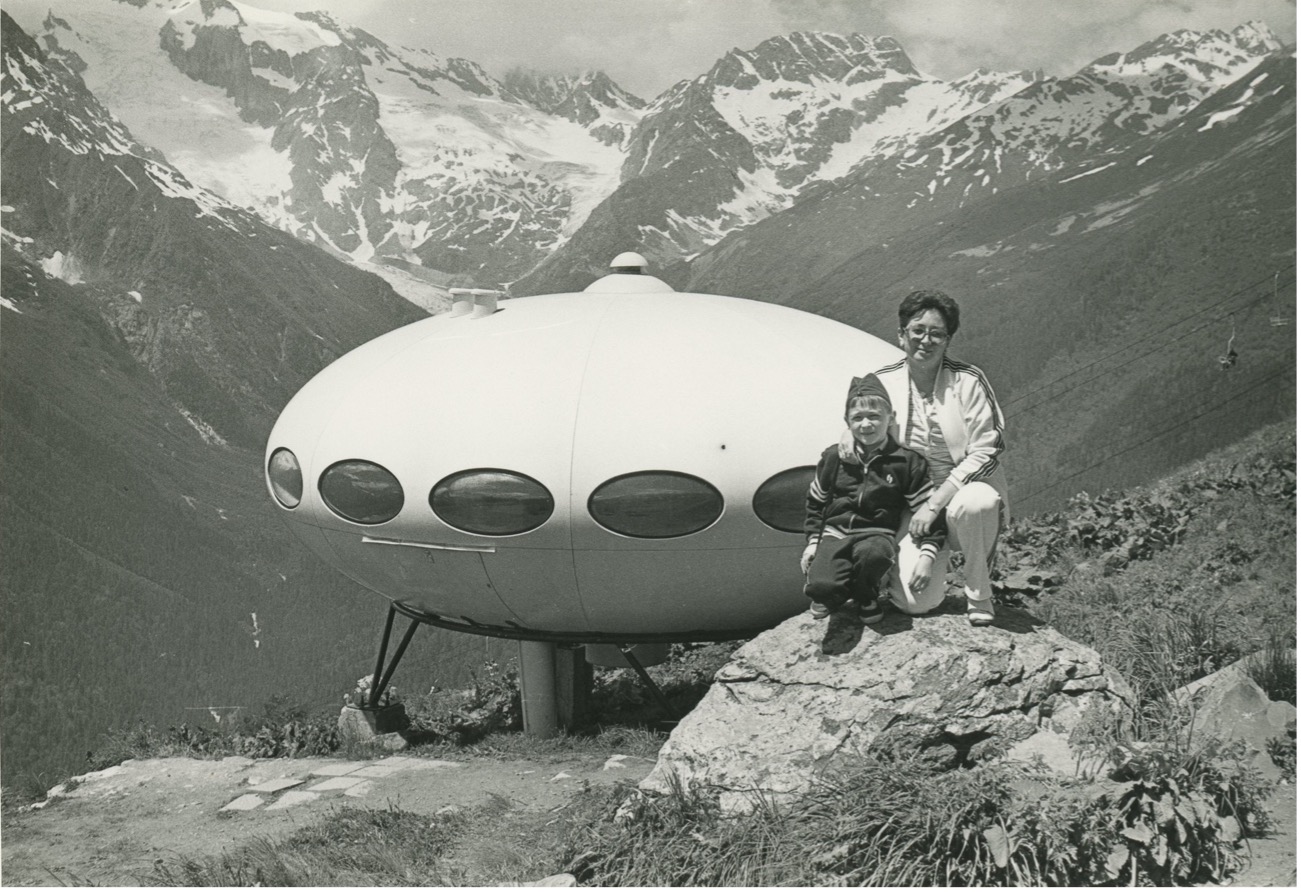
For two weeks my grandfather and I aimlessly wandered around the town, drinking Kislovodsk’s famous mineral waters (Kislovodsk literally means “sour water”). I had my Smena 8 with me and I kept snapping photos of mountains, strangely dressed people from Caucasus’ highlands, monuments, and really anything that came across my lens. At some point we came across a little photo processing booth in the middle of a city park. I dropped off two rolls of film for processing; when I came back two days later to pick them up, maybe three or four frames out of both rolls could actually be printed. I was pretty upset and might have thrown a tantrum. I kept crying, saying over and over again how my parents gave me a broken camera that cannot produce a single decent photo.
The man who ran the photo booth came outside, took my camera from me, and showed me the basic settings. He explained how to estimate distance, and how aperture and shutter speed settings must be different depending on the light outside. He grabbed a piece of paper and drew a table of camera settings; he promised that if I followed the table my next roll of film would come out well.
I never found out the man’s name. I don’t ever really remember what he looked like; the only thing that comes to mind is a short-sleeved checkered shirt. My next roll of film came out with only three or four frames ruined – everything else was well exposed and in focus. And the next roll, and the next. If I did not chance across this particular photo booth where the attendant actually took the time to talk to a crying kid, I might have never fallen in love with photography.
After two weeks in Kislovodsk my mom finally managed to take a vacation and come to stay with us; a few days later my grandfather went back to Gomel.
The kid from whose family we rented a room was trouble. His name was Sasha and he raised hell everywhere he went. In the short time that I knew him, he landed me in the emergency room twice. The first time he convinced me to juggle flaming torches. Since we did not have actual torches, we made them by attaching parts of plastic toys to sticks and lighting them on fire. The first round of juggling went surprisingly well – we tossed back and forth a flaming plastic bear attached to a stick. Juggling with just one piece seemed lame, so we made a second torch from a plastic doll. As it turned out, managing two flaming objects was more difficult than I expected. On the second or third throw I caught the flaming bear not by the stick but by its fiery head. The burning plastic immediately stuck to my skin, resulting in a second-degree burn to my palm.
A week later Sasha convinced me to have a jumping competition, where we would climb on fences, tree branches, windows, and jump down. We egged each other on; if one of us hesitated before a jump, the other would yell “salabon” (weakling). This went on for a while, until we made it to the roof of an abandoned two-story building. It was my turn to jump. I looked down. The lot below was covered in scrubby grass and broken office furniture. “If you jump over there,” – Sasha pointed down to a spot of grass that was relatively clear of refuse – “you’ll be OK.”
One thing I forgot to mention – Sasha and I made a bet. He bet his bike and I bet my camera. The first person to back out of a jump loses. I looked down again. A view down from a two-story building would seem pretty high to an adult, and even more so to a 9-year-old child. I sat down on the edge and considered backing out. “If you piss yourself,” – said Sasha, “I get your camera.” That was the deciding moment for me. I wasn’t worried about getting in trouble with my mom, or about getting hurt. I did not want to lose my camera. So, I jumped.
Surprisingly, I landed right on the spot that was clear of debris. I landed on my feet and did not break anything. Except for my nose. When I landed, somehow my right knee connected with my nose. I heard a crack and horrible pain exploded in my head. I must have passed out, because when I did manage to open my eyes, Sasha was standing over me, spitting water in my face.
For the next week, I was quite a sight. My right hand was wrapped in a gauze bandage and smelled strongly of some kind of burn ointment. My nose was crooked – the ER doctor did not do a good job setting it. Most of my face was black and blue from bruising. Thinking back, I wonder if people who saw me thought that my parents abused me.
One of the most memorable moments of this trip (besides a second-degree burn and a broken nose) was a guided excursion to the foot of Mashuk mountain in Pyatigorsk. On that very spot-on July 27, 1841, a legendary Russian poet Mikhail Lermontov was killed during a duel with his Cadet school friend Nikolai Martynov. To my nine-year-old’s ears our tour guide was the best storyteller I have ever met. She painted a picture of Lermontov’s private and public life, writing, exiles, and loves that I could actually imagine being there, in Pyatigorsk salons, or at the Mashuk mountain cliffside. I could see Lermontov raising his gun to fire into the air; I could see Martynov pointing his gun at Lermontov’s chest and pulling the trigger.
During the “free time” of the tour I approached our tour guide, asking her how she managed to get so good at taking dry facts and presenting them as enchanting stories. She took my questions very seriously. While the rest of the tour group explored the site of the duel or drank tea at a chayhana, she sat with me on a bench and told me that she studied journalism at the Pyatigorsk State University and worked as a tour guide during the summer. I vaguely knew that journalists were people who wrote for newspapers, but that was about it. She told me that she wanted to study photojournalism, but the University only offered a traditional journalism degree. To learn photography, she enrolled in every workshop she had access to and joined every photography club in the Pyatigorsk area. She told me about famous Soviet photojournalists, people like Boris Ignatovich, Moisei Nappelbaum, Yevgeny Khaldei, and Yury Abramochkin. She told me about Western photographers such as Robert Capa, Henri Cartier-Bresson, George Rodger and David Seymour, and how they formed an agency called Magnum.
I was absolutely enthralled. At that moment I decided that I would become a photojournalist. I read every photography book and every issue of Sovetskoe Foto (Soviet Photography) that I could get my hands on. I joined a photography club, but the gentleman who ran it was only interested in art photography and would spend hours drilling us on how to make a perfect black-and-white print. I reached out to local newspapers, such as Gomelskaya Pravda, begging for an opportunity for someone to review my photographs or to shadow an actual photojournalist. At best, I would get a pat on the head and a condescending smile. At worst, I would get laughed at.
I dreamed of working for such major Soviet newspapers as Trud (Labor), Pravda (Truth), and Izvestiya (News); in my teen years, I imagined covering wars for such venerable agencies as Magnum and Associated Press.
When Mikhail Gorbachev became the General Secretary of the Communist Party of the Soviet Union in 1985, he introduced two new concepts – perestroika and glasnost. Perestroika (meaning “rebuilding”, or “reconstruction”) was Gorbachev’s attempt at restructuring the Communist Party of the USSR and introducing new political and economic reforms. Glasnost (meaning “openness”) was the first Soviet endeavor to allow freedom of speech and freedom of the press. One of the unintended consequences of Glasnost was an explosion of yellow press. Seemingly overnight newspaper kiosks became flooded with publications about conspiracy theories, UFOs, and alien abductions. I grew up knowing that newspaper articles were reviewed by editors and censored by the government. In other words, I (and probably most of the Soviet citizens) believed that if something was published in a newspaper, it must be true.
In the spring of 1990, I came across a newspaper article that described an expedition to a UFO landing site near my hometown of Gomel. When I saw the description of the landing site, my heart stopped. I knew that spot! My friends and I camped there on many occasions, and as a kid I even went to a young pioneers’ camp in the area. I immediately called a few friends and we decided to investigate. The next day instead of going to school, we left our school bags in the basement of one of my friends’ apartment buildings and took a bus across town to Solnechnaya, a newish neighborhood of concrete-block apartment buildings at the edge of the city. From Solnechnaya, it was an hour hike through familiar trails to our favorite camping spot, now an alleged landing site of a mysterious UFO. We were prepared for every eventuality. All of us had knives in case we had to defend ourselves, rolls of tin foil to protect us from alien radiation, and cameras to capture alien visitors on film. The closer we got to the campsite / alien landing site, the quieter we became. We got off the main trail and walked quietly through soft piles of rotting pine needles, hiding behind tree trunks. Within fifty yards of the site, we got on the ground and crawled. I put my knife in my teeth Rambo-style, propped myself up on my elbows, and focused the camera at the big fat nothing in the clearing. There was no landing site. There was no UFO. There were no aliens.
We burst into the clearing, just to make sure that the aliens were not hiding from us using some kind of advanced cloaking technology. Upon closer inspection, there still were no aliens.
Disappointed, I shot an entire roll of film documenting the empty clearing and the glaring lack of alien life. The next day, I wrote a scathing letter to a local newspaper. I included a clipping with the UFO landing article, my photos, and a long diatribe about journalistic integrity and the absolute necessity of fact-checking. To my surprise, my letter ended up being published along with my photo of the empty clearing. All of a sudden, I was a published journalist!
My dream of being a photojournalist turned from a dream to an obsession. I spent every waking moment wandering around with a camera, trying to find stories, honing my “decisive moment” skills. I spent all of my allowance money on film and darkroom chemicals. I spent so much time in the darkroom developing film and printing black-and-white photos that at one point my homeroom teacher contacted my parents and complained that I had a “weird chemical smell”.
In 1991, at the age of 14, I came across photographs by a Soviet photojournalist Alexander Sekretarev who covered the war in Afghanistan for Izvestia and was killed in the line of duty in 1988. His grainy black-and-white photos showed the war both from the perspective of Soviet soldiers and from the perspective of Afghan mujahideen fighters. Looking through his photos, I began to wonder what life in Afghanistan must be like now, after the withdrawal of Soviet troops.
During the height of the Soviet-Afghan War, a famous Soviet bard Alexander Rosenbaum performed in Afghanistan for Soviet soldiers. I grew up with Rosenbaum’s songs and idolized him along with other Soviet bands, such as DDT, Nautilus, and Aquarium. After his visit to Afghanistan, Rosenbaum wrote a song called “Black Tulips”. “Black Tulips” was a nickname for the cargo planes that brought back zinc coffins with Soviet soldiers killed in Afghanistan. That song, along with the stories I have heard from older brothers of my friends, originally made me live in terror of being drafted into the army to serve in Afghanistan. Now, that song inspired me with an idea to run away from home and to find my fame as a photojournalist by photographing post-Soviet life in Afghanistan.
To build up my journalistic skills and to build my “war journalist” portfolio, I convinced a few of my friends who were also interested in photography to hang around militsiya[1] stations in different neighborhoods, follow street patrols, and photograph crime scenes, arrests, and any violent action scene that we may encounter. For the next few weeks, I hung out almost every evening across the street of Otdelenie Militsiyi No1, police station #1 of Gomel’s Central District. Armed with my trusty Zenit ET with a 135mm lens and a Fed 3 (incidentally named after Felix E. Dzerzhinsky, founder of the NKVD) with a 28 mm lens I tried to photograph criminals being led from militsiya cars with their hands cuffed behind their backs, drunks resisting arrests, and on a few occasions, distraught women crying and begging to be allowed to see someone who’s been arrested.
On one occasion, I decided to follow a patrol of three heavily armed OMON officers. OMON is an acronym for “Otryad Militsii Osobogo Naznacheniya”, literally meaning “Special Purpose MilitsiyaUnit”, in structure and in training very similar to SWAT in the United States. I wasn’t sure why OMON was patrolling the streets, but I had heard some rumors of two racketeering groups having a shootout over a restaurant. I hoped that the OMON patrol was preparing for a raid, or really for anything that would result in a violent action worthy of a photojournalistic portfolio.
As it turned out, spying on a trained rapid-response team with a camera was not a great idea. A few blocks after the militsiya building the OMON team turned into an alley. I grabbed my Fed with its fast Industar-69 28 mm lens, opened the lens to f2.8, set the shutter speed to 1/15th of a second, brought the rangefinder to my eye and stepped into the alleyway. Immediately, one of the OMON guys grabbed me and twisted my arms behind my back, while another one slipped both cameras off my neck. They handcuffed me and marched me back to the militsiya office.
For almost an hour a young militsiya lieutenant interrogated me, trying to get to the bottom of what I was doing following an OMON patrol. Someone took my cameras away and brought them back 20 minutes later without film. Another person took my passport and left me sitting in the room for another half an hour. I don’t know if the lieutenant bought my “photojournalism portfolio” story, but finally around 10PM he told me that I was free to go. I thanked him, took my passport and my cameras and headed for the door. Another young militsiya officer blocked my path. I turned to the lieutenant. “What’s going on? I thought you said that I could go?”.
“You are free to go,” – said the lieutenant. “But I never told you that you are free to go through this door.” He walked to a window and flung it open. “If you want to be a photojournalist in Afghanistan, maybe you need to get used to jumping from helicopters. Here is your first free lesson!” He pointed to the open window. I walked up to the windowsill and looked down. We were on a second floor, with the window facing an empty street. “Tick tock,” said the lieutenant, pointing at his watch. “I don’t have all night. Either you parachute out of this window, or you can spend the night in obeziannik[2]. I put both of my cameras around my neck, zipped my jacket around them to prevent them from swinging around, nodded to the lieutenant, and jumped. This flight was shorter and more successful than the one I did on a bet as a child in Kislovodsk. I did not break my nose (or anything else for that matter). The only thing that I was really upset about was the loss of two rolls of film.
[1] Militsiya (Russian: милиция): the name of the police forces in the Soviet Union until 1991.
[2] Obeziannik (Russian: oбезьянник, literally “monkey cage”) – slang for a cage-like jail in Russian police stations for pre-charge detention
 Dmitriy B.
You must be logged in to post a comment.