I remember Gehrman Abram as a small wiry man who always wore a beret and carried an old Zenit camera everywhere he went. Gehrman spoke at least five or six different languages. Somehow, he managed to procure newspapers in English, French, German, and Spanish; during his visits he would always lounge around in the kitchen with one of these newspapers, reading and drinking pungent Turkish coffee. Gehrman was missing his left arm. As a kid, I was always afraid to ask how it happened and I tried really hard not to stare at the empty sleeve folded and pinned around an empty shoulder socket. Gehrman was the one who helped me cultivate my love for photography. Soviet-manufactured film was sold in rolls sealed in foil, not in disposable plastic film canisters like in Europe or the United States. Photographers had to load the film into reusable film canisters in a darkroom, or at the very least in a dark bag. At home, Gehrman’s wife would help him load the film; when in our house, I was the film loader. Gehrman would take me on photo walks around the neighborhood, deftly changing his Zenit’s settings with one hand and talking about how you did not need to go far away from your home to notice interesting things. I dutifully followed, my beat up Smena 8 in my hands, trying to replicate his perspective and composition.
Gehrman also encouraged me to speak French. In Soviet schools a foreign language was a requirement, but students did not begin learning a new language until 5th or 6th grade. My school specialized in French and that language was introduced in 2nd grade. By middle school we had three subjects in French – language, literature, and technical translation. By high school I read Alexander Dumas and Jules Verne in the original and translated helicopter maintenance manuals from French to Russian. Gehrman spoke French fluently and would always leave me French newspapers after his visits. For some reason, I seem to remember a heading of “L’Elephant”, but I’m not sure if it was the title of an article or an actual newspaper name. I also learned my first French curse words from him – I think I was the only 5th-grader in my school who would walk down the hallways yelling “merde” and “putain”.
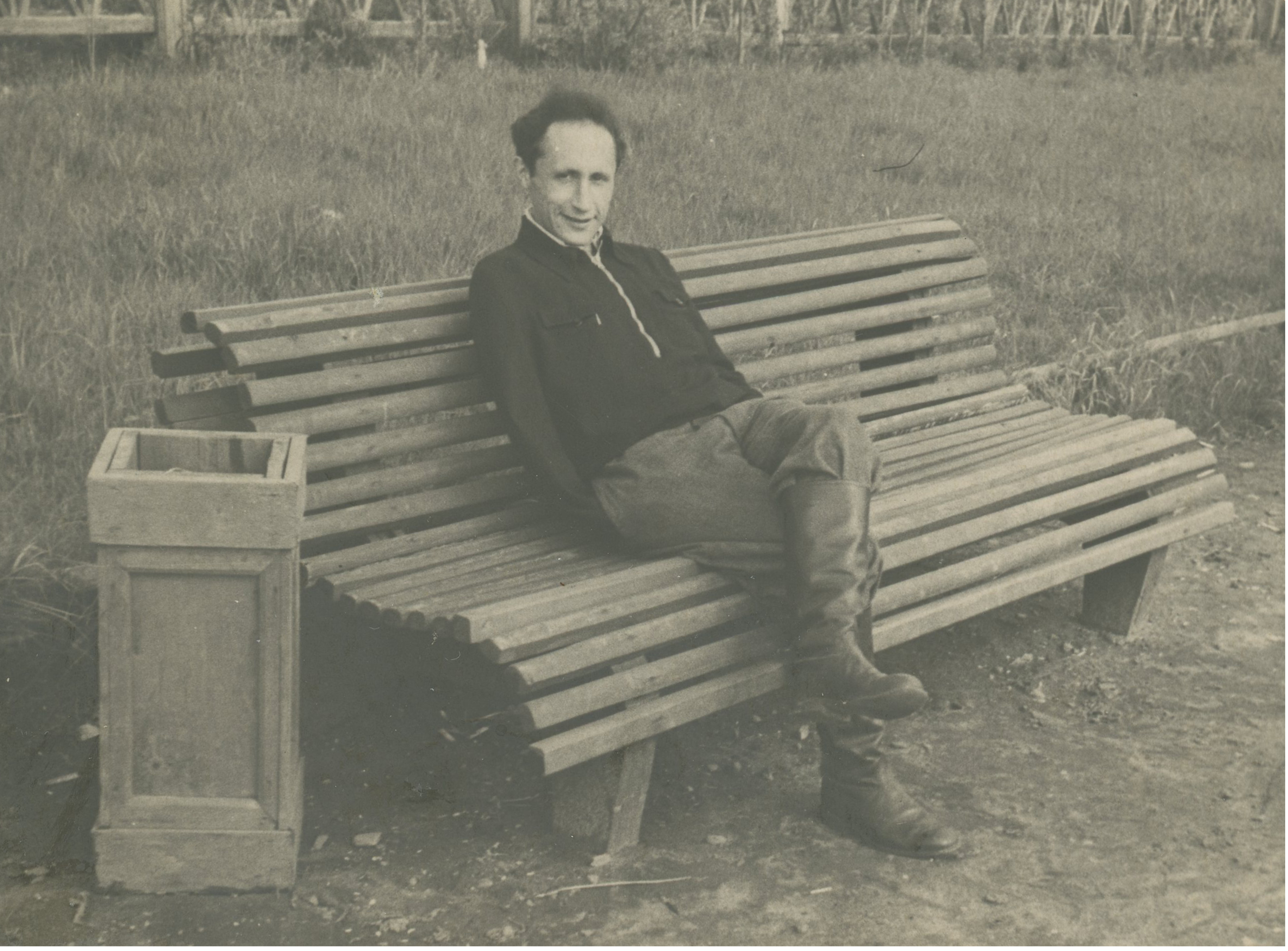

The last time I saw Gehrman was in 1989 – he visited us in Gomel a few months before he and his family immigrated to Israel. At the time of his last visit, I barely spent any time with him – my father was in the hospital after suffering a work-related accident and I was stuck babysitting my 2-year-old sister. To be quite honest, I completely forgot about Gehrman until I came across his name is my grandmother’s old address book, two or three years after my grandfather’s death. I copied Gehrman’s address and phone number from my grandmother’s address book and forgot about it for another year or so. When I interviewed Mr. Fishman in Florida, Gehrman’s name came up multiple times; when I returned to Pittsburgh, I dialed the number from my notes. The phone rang and rang, but no one answered. No answering machine, no voicemail. Over the next few weeks, I tried calling repeatedly at different times of day, cognizant of the time difference between Israel and the U.S. East Coast. Not having any luck reaching Gehrman by phone, I wrote a long letter. At the time, I had lived in the United States for close to 10 years and had few reasons and few opportunities to practice writing in Russian. While my spoken Russian was perfect, my written grammar and punctuation left a lot to be desired. With help from my mom, I hand-wrote several pages, reminding Gehrman of who I was and why I wanted to speak to him. I mailed the letter without much hope of getting a response.
A few months have passed and just as I started to think that maybe Gehrman passed away, I found an attempted mail delivery note (signature required) stuck to my door. The next day I stopped at the post office on my lunch break and picked up a bulging envelope covered in Israeli postage stamps. Holding my breath, I ripped open the envelope and took out a thick sheaf of lined notebook pages covered in Gehrman’s chicken-scratch handwriting, each letter slanted to the left.

“Hello, Dima. I finally managed to get back to you. Lately, one thought has been bothering me. What should I write about? More than half a century has passed since those trials and tribulations, and many things have been erased from my memory. Lately, from time to time I try to write things from memory, and even try to publish some of them. It is amazing how short our memory is, especially when it comes to personal tragedies…”
I thumbed through the sheaf of pages. He wrote seventeen pages. Double-sided. By hand. I carefully folded the letter back into its envelope and went back to my office. For the rest of the day, I did not do any work. I scanned the pages to make sure that I have a digital copy in case anything happened to the original letter, packaged the letter into a mylar envelope, and started reading.
Over the next two weeks I re-read Gehrman’s letter at least five or six times and filled a notebook with notes. Several times I could not make out his handwriting, so I had to ask my mom, and a few of my Russian-speaking friends to help me decipher certain words and phrases. At the end of his letter, Gehrman included a phone number – turned out that my grandmother was off by one digit in her address book. Over the course of the next year, Gehrman and I spoke many times, about his experiences in the GULAG system, about my grandfather, and about many others whose lives intersected behind the barbed wire fences and in coal mines of Vorkuta.
Gehrman was born in Gura Humorului, in northeastern Romania. While Gehrman was willing to talk extensively about his experiences in GULAG, he never discussed his childhood, how he ended up in the Soviet Union, or his arrest. The few times when I attempted to ask him either directly or indirectly, he would immediately change the subject.
Just like many other foreign skilled workers, he was shipped off behind the Urals to work in an evacuated factory as a gas line maintenance worker. Through GULAG archives I managed to find out that he was arrested in Saratov on March 7 of 1945, only a few months before the end of World War II. Accused of espionage and attempted murder, he was formally convicted by a closed NKVD session on December 29, 1945, and sentenced to 8 years of corrective labor.
In his letter to me Gehrman lamented not having a diary. He told me that without a reliable source such as a personal journal, “it is impossible to tell a personal story for any given GULAG inmate – the story of every inmate who ever went through the GULAG system is the timeline of GULAG itself. “
Gehrman and my grandfather met under rather tragic circumstances. GULAG inmates were transferred from one camp to another without any warning – the administration did not want groups of people to communicate and stay in contact for extended periods of time. The wounded and the sick were the exception – those who required long-term “medical” care stayed in the same barrack for extended periods of time.
One day, when Gehrman was working on the mechanical system that pulled coal carts from the mines, a coal cart collapsed and crushed his arm. He passed out from the shock and several prisoners carried him to the infirmary. Gehrman regained consciousness on the operating table, right as the surgeon placed a chloroform mask on Gehrman’s face.
Gehrman woke up from a searing pain in his shoulder. He opened his eyes and tried to touch his left arm. There was nothing there. As he felt his way up the side of his body, his fingers touched a large bundle of gauze tightly strapped against his left shoulder. The arm was gone.
There were no pain killers and no antibiotics. Many people who suffered injuries died from post-surgical infections; some ended their lives because they could not stand the pain or could not imagine coming back to normal post-GULAG lives without four working limbs.
A few days after the amputation the pain became worse, and Gehrman started running a fever. The amputation site became infected.
Gehrman could not sleep or eat. He could barely hold down water. As he tossed and turned, sweating despite the frigid air in the barrack, my grandfather, who was in the same infirmary recovering from scurvy and pneumonia, took care of him. Together with Mikhail Zaytsev and Ilya Rozinko, they fed Gehrman small pieces of bread soaked in water, made him drink the watery balanda, and put snow on his forehead to bring down the fever.
At some point, a doctor came in to check on Gehrman. The doctor, a bitter man in his late 20s, hated being in Vorkuta. In the Soviet Union, teachers, doctors, engineers, and other professional graduating from universities did not choose where they would go after graduation. The state “distributed” professionals based on its own needs, and graduating students had little to no say in where they would end up after a university. Unless, of course, your parents were communist party bosses, or your family had enough money or resources to bribe the right person. The doctor obviously lost the placement lottery; instead of a highly desired spot in Moscow or Leningrad, he ended up in Vorkuta.
The doctor sat on a stool next to Gehrman’s bed and lit a cigarette. He blew out a cloud of smoke and looked around the barrack. My grandfather, Mikhail, and Ilya stood at the side of the bed. The doctor glanced at Gehrman’s sweaty forehead, the blood spots seeping through the gauze, and shook his head. “I don’t think we can do anything for him. I might be able to get him some morphine to make him a bit more comfortable, but he is not going to make it.” The doctor shook his head again and left the infirmary.
Ilya and Mikhail looked at each other. Mikhail said something to Ilya and left the barrack. There were rumors of a German doctor, a former Nazi surgeon who specialized in field amputations and whose patients had a very high survival rate. Mikhail tracked down Pavel Zhizhin, one of the few sympathetic guards who treated political inmates with respect. Mikhail asked if he could find the German doctor.
When Pavel finally brought the German doctor to the infirmary barrack, Gehrman passed out from pain and high fever. The doctor examined the amputation site and told the guards that Gehrman would need another surgery, that the amputation site would have to be reopened to drain the pus. The young Soviet doctor who was supervising the infirmary and the surgeon who performed the amputation refused – they claimed that they did not want a Nazi to operate on their patients. In reality, they probably were too afraid of giving up even a shred of their authority, especially to someone who would very likely expose their incompetence. As they were arguing, Gehrman began to seize. His whole body shook uncontrollably, limbs twisting, the back of his head hitting the edge of the nary. Pavel stepped in front of the infirmary supervisor and pointed towards Gehrman. “This man is an expert in mining machinery! If he dies, who is going to maintain the mining equipment? Do you think you could do it? Are you willing to delay coal production? Should I ask your nachalnik what he thinks about this situation?”
The doctor immediately deflated. He exchanged a defeated look with the surgeon, spat on the floor, and walked out of the infirmary. The surgeon turned to the German doctor and said in a flat voice, pointing at Gehrman: “You better save him.”
The next couple of weeks were a blur. The German doctor reopened the amputation site, drained the pus, and disinfected everything the best he could. Without antibiotics and pain killers, …
In his 2003 letter, Gehrman mused about a German doctor who saved a Jew. “A Jew saved by a former Nazi. He must have tried to atone for something.”
 Dmitriy B.
You must be logged in to post a comment.