My grandparents played a huge role in my life. My mom and my grandmother taught me how to read and write and fussed over my general well-being. Before his cancer diagnosis, my grandfather made me get up every day at 7 AM and took me running. He taught me how to build and fix things, how to use power tools and how to defend myself in a fight.
My vision and my memory of my grandfather do not match that of my mother. She often remembers him as tough, authoritarian, demanding, and sometimes downright cruel. He was never mean or cruel to me. As a matter of fact, I recall only three events when I got in trouble.
In the 1950s and the 1960s, the Soviet Union experienced a tremendous housing crisis. An average Soviet citizen could not simply buy a house or an apartment. An average Soviet citizen could not even move from place to place because of propiska (прописка), a stamp in the state’s internal passport permitting a person to live in a given place. Millions of people lived in kommunalnaya kvartira (коммунальная квартира), communal apartments where entire families lived in single bedrooms and shared the kitchen and the bathroom. In order to get an apartment of their own, regular Soviet families and individuals had to be placed on special waiting lists, where they could wait for years before an apartment became available.
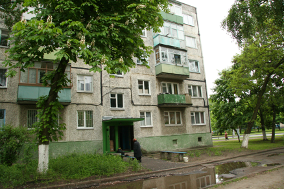
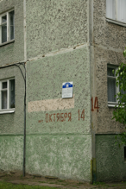
Apartment building at 14 October Prospekt, Gomel. This is the apartment building where I grew up and lived for the first 16 years of my life. Photo taken in 2006.
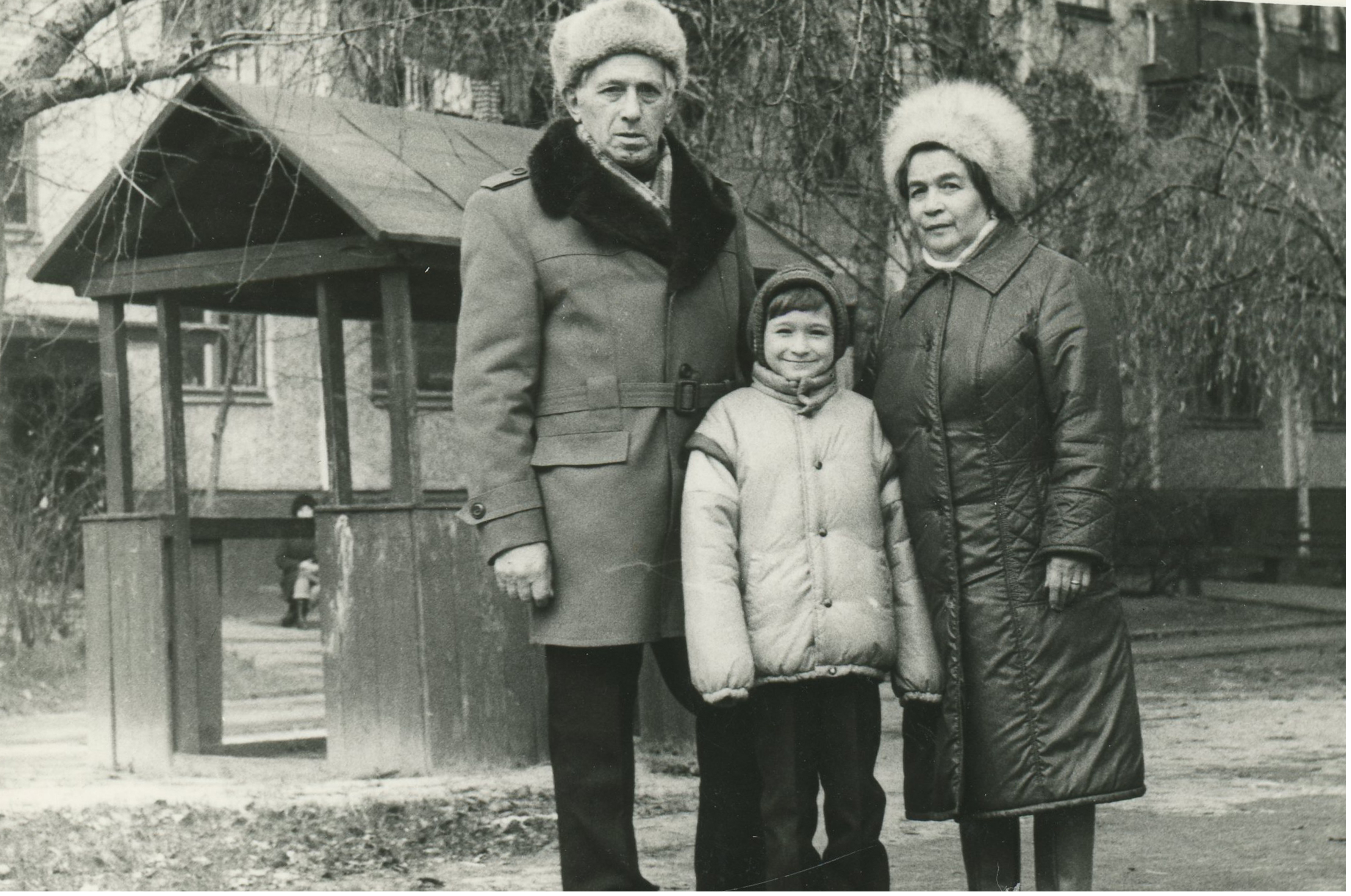
On the playground in front of our apartment building. My grandfather Arkadiy Payes (left), me (middle, age 10), and my grandmother Olga Payes (right). 1986.
To relieve the housing shortage, the Soviet General Secretary Nikita Khrushchev approved mass production of prefabricated 5-story concrete panel buildings that became known as khrushchyovkas (хрущёвки). If you were to visit almost any former Soviet republic today, you would find khrushchyovkas everywhere. While they may be looking a bit worse for the wear on the outside, there is one thing about them that would never change. If you ask any person who grew up in the Soviet between the 1970s and today and who lived in a khrushchyovka about their favorite part of their childhood, they will all answer the same thing – basements.
The Catacombs of Paris and the New York subway system have nothing on khrushchyovka’sbasement system. While each building looked virtually identical on the outside, basements had lives of their own. Initially designed as a grid of cement storage units to be used by the apartment building’s residents, they were transformed into dark and dangerous mazes by a series of doors, walkways, and corridors haphazardly installed by anyone with access to a hammer and wooden planks. Steam pipes with asbestos insulation, random pieces of furniture discarded from the residents’ apartments, and rusty sharp things of unknown origin lurked in the darkness. These basements were an adventurer’s dream, and every kid who grew up in the Soviet Union spent a significant time exploring basement passages and occasionally ended up in the emergency room after stepping on a rusty nail.
Unlike most of our neighbors, my grandfather did not use our basement area for storage. Instead, he converted it to a woodworking shop. Our basement area had an actual door with a padlock, the concrete walls were covered with unfinished wood paneling, and the homemade shelves sagged under the weight of various tools. When you walked into the workshop (I will no longer refer to it as “basement”), the first thing you saw was a long wall-to-wall workbench, complete with a set of woodworking vices.
As a kid, I was interested in many things, but there was one thing that I was really obsessed with. Medieval weapons. I obsessively read every book that I could find on swords, bows, crossbows, and trebuchets. It is that last one that really got me in trouble with my grandfather.
I don’t remember when or where I saw a picture or a description of a trebuchet, but I distinctly remember thinking that I needed to build one immediately. Unfortunately for me, trebuchets are rather massive and require a lot of wood to build. Instead of trying to build a smaller-scale model, I went all in and decided to build a full-size trebuchet, one that would be powerful enough to knock down the walls of my school.
As this idea started to develop, I conscripted my two best friends, Anton and Kirill, to help me with the project. Anton was a year older than me, a good-looking kid who perpetually got in trouble and constantly failed to turn in his schoolwork. He lived in an apartment building across the street from mine. We had known each other for as long as I could remember; even our mothers went to school together and had been friends for years. Kirill was a year younger and lived in the same apartment building as me. His mom disapproved of our friendship; even though I rarely got in trouble she thought that I was too adventurous to be friends with her son. That did not stop Kirill from hanging out with us and from occasionally getting in trouble.
The first order of business was wood. Just like everything else, building materials were difficult to come by in the USSR. Most of what my grandfather had in his workshop came from wooden crates, leftover construction lumber, and scrap from previous projects. Whatever he had was not nearly enough to build the massive trebuchet of my dreams.
Lucky for me, there was a bottle recycling warehouse a few blocks from our apartment building. Milk, lemonade, and vodka bottles were recyclable. As a matter of fact, most kids my age got their spending money from collecting bottles and selling them to recycling facilities. Milk bottles cost 15 kopeks, lemonade and vodka bottles 20 kopeks. A few bottles sold to a recycling center would pay for a movie and an ice cream, so you never walked by an empty glass bottle without taking it home, rinsing it, and squirreling it away for the future.
The recycling center near my house was in the middle of a populated residential area, with a tall wooden fence separating the warehouse from the surrounding apartment buildings. I think you can see where I’m going with this. My friends and I decided to recycle the wood from the recycling warehouse’s fence and use it to build a trebuchet.
I don’t remember exactly what excuse I made up to sneak out of the house late in the evening, but I do remember grabbing a hammer and a crowbar from my grandfather’s workshop and running down the alleyway between two khrushchyovkas to the recycling warehouse. Anton and Kirill met me there, dressed in all black and looking like ninjas. I remember thinking that it was funny that they dressed like Japanese warriors to steal wood to make a medieval European weapon.
We pulled off as many boards as we could carry and hid them away in an unused corner of my apartment building’s basement. Happy with our progress, we agreed to repeat the raid the next day and went to our respective apartments.
Unfortunately, my friends’ ninja outfits did not stop the ever-vigilant babushkas from seeing us. When I immigrated to the United States, I was shocked to find out that the word “babushka” refers to a headscarf worn by old ladies. In Russian, the word “babushka” literally means “grandmother” but is generally used as a respectful reference to old women. Soviet babushkas are terrifying creatures. They wile away the hours by sitting on a bench by the front entrance to the apartment building, keeping track of all the comings and goings, gossiping and complaining. As kids, we used to joke that all babushkas worked for the KGB.
Before I even managed to walk up four flights of stairs to my apartment, one of the babushkas called my grandfather to ask why his grandson was stashing a bundle of boards in the basement. Following a brief (but effective) investigation, my grandparents determined where the boards came from, why I needed them, and who my co-conspirators were. I have never seen my grandfather so mad. As a punishment, I was banned from the workshop for a month. What was even worse than losing my workshop privileges was that I had to take the boards back to the recycling warehouse, confess to my crimes, and apologize.
Over the course of my childhood and adolescence, I have built numerous weapons, accidentally shot one friend in the ass with a crossbow bolt, just as accidentally fired a homemade muzzleloader into a neighbor’s window, blew up a toilet bowl, got busted for fishing with explosives made from fertilizer, and set our balcony banister on fire. Interestingly enough, my grandfather never punished me for these screwups. As a matter of fact, I don’t remember either of my grandparents ever getting mad when a neighbor or a friend’s parent showed up at our door, complaining about my latest adventures in warfare engineering.
Setting the balcony banister on fire deserves a bit more of a backstory. I was probably around 14 when my parents gave me a model airplane kit. Now, keep in mind that the year was 1991, and radio-controlled airplanes or drones simply did not exist (at least not in the USSR). My model airplane (or actually a biplane) had a balsa wood fuselage, two balsa wood wings, and a tiny electric motor with a propeller. The kit came with a very long string – once the airplane was airborne, it flew around in circles, tethered to my hand by a few meters of sturdy nylon.
I quickly got bored of flying the biplane in circles and decided to spice things up. By this time in my life, I was over the medieval weapons and focused all of my efforts on space exploration. Translation – instead of projectile weapons, I started building rockets and experimenting with various homemade fuels and explosives.
I decided to convert my biplane with its tiny lame electric motor into a jet. I had almost all the tools and parts I needed, except for one thing. I did not have any jet fuel. Luckily, a few months before my attempted jet conversion I came across a small softcover brochure by Anatoly Silantiev titled “Solid Rocket Fuels.” A little knowledge is a dangerous thing. I did not understand most of what I read in Silantiev’s book, but in my mind, I saw a clear direction on how I could make a rocket engine using a couple of aluminum pipes and a bit of gunpowder.
I cut two short lengths of aluminum pipe and hammered and welded one end of each piece completely shut. I packed the pipes with gunpowder from two hunting shells and partially sealed the open end shut, leaving a tiny opening for the explosive gases to escape. Once my “engines” were ready, I removed the tiny electric engine from the biplane and attached the two pipes under the top wings, positioning them like turbines of passenger airplanes. I made two fuses, one for each “engine”, from gasoline-soaked twine.
I knew that airplanes needed a runway to gain enough speed to become airborne. The original electric engine version of the plane could be launched into the air simply by gently throwing it, kind like you would with a paper airplane. With my brand-new jet version, I was worried about being burned, so launching it from my hands wasn’t an option. Naturally, I decided to turn our balcony into a launchpad. I took a three-meter-long sheet of plywood and nailed it at an angle to the balcony banister. I figured that the plane could use the three-meter distance for initial acceleration; after it reached the end of my improvised runway it would go over the edge of the banister and be airborne. I had enough common sense to build barriers around the “runway” out of 15-centimeter-high boards. When I decided to build the barriers, I was mostly worried about the plane veering off before the takeoff. As it turned out, these barriers saved our windows and probably my eyesight.
When my grandparents left the apartment to go grocery shopping, I set the plane on the improvised runway and lit the fuses. I had enough presence of mind not to stay on the balcony – I went back inside the apartment and pressed my face against the window, waiting for the fuses to ignite my “jet fuel”.
The explosion was pretty spectacular. The biplane disintegrated in a fireball, igniting the runway and the banister. The shrapnel from the pipes shredded the screen door and embedded itself into the doorjamb. I could hear pieces of metal pinging off the exterior cinder block walls.
I quickly put out the fire and cleaned the balcony the best I could. I took the burned runway and the remains of my biplane to the dumpster behind the apartment building. I swept the balcony, used pliers to pull pieces of metal from the doorjamb, and taped the tears in the screen door. There was nothing I could do about the burn marks on the banister.
When my grandparents got home, they were surprisingly calm about the damage. My grandmother looked me over to make sure that I wasn’t bleeding and did not have any stray pieces of metal embedded in my flesh. My grandfather disappeared for a few minutes; when he came back, he handed me a wire brush, sandpaper, a paintbrush, and a can of paint. I guess that by that point in their lives they were used to things blowing up, flying, or catching fire around me.
The second and the third time my grandfather got mad at me had nothing to do with my engineering endeavors.
From the age of 10 to about the age of 13 I took swimming lessons at the Dvorets Kultury Chimikov (Palace of Culture of Chemists). Almost every city in the Soviet Union had a Dvorets Kultury (or DK), a major community center dedicated to all kinds of recreational activities and hobbies: swimming, fencing, arts, engineering, and collecting. The DK Chimikov was a 30-minute walk from my house. Every Monday and Wednesday I would run home after school, grab a quick bite to eat, grab my gym bag, and walk to the DK for a swimming practice. I wasn’t the strongest swimmer, but I could hold my own and over the years had made a lot of friends with my teammates.
One evening in December, right before the start of the winter break, everything changed. A new kid who recently joined the team somehow found out that I was Jewish. He was a big kid, a good swimmer with a mean streak and an innate ability to quickly identify someone’s weakness and press on it until it hurt. He quickly established dominance on the team and just as quickly turned everyone against me. After each practice he and his minions would dance around me in the locker room, screaming “Zhyd, zhyd, po verevochke bezhit” (Jew, jew, running on a rope).
On that December evening, he decided that it would be funny to hide all of my clothes and my gym bag while I was in the shower after practice. When I came into the locker room, everyone was gone, and so were my clothes. We were the last swim practice of the day, and it wasn’t uncommon for us to be the last ones to leave the building. I was left with my swimming trunks, a sweater that my tormentors somehow failed to take, a wet towel, and my winter boots. Everything else (and everyone else) was gone. I ran around the building, trying to find someone who could help me, but everyone left for the night. I tried finding a phone, but the receptionist locked her phone in her desk and I did not have any coins for a pay phone. I had two choices – I could stay in the building overnight and wait for someone to show up in the morning, or I could run home seminaked through the freezing nighttime streets.
The thought of being alone in the giant empty DK building terrified me, so I chose to run. Dressed in wet swimming trunks, winter boots, and a sweater I ran through snowy streets. I was so upset and so terrified that even when a few passerbys tried to stop me and help me I ran past them, completely ignoring their attempts to help.
The next morning my grandfather went to my school and spoke to the principal. He went to the DK administration, to the swimming coach, to everyone who would listen. No one did anything – they just shrugged it off by treating it as a prank and saying, “boys will be boys”. I think it was the helplessness more than anything else that had made him so furious.
The second time was a few years later, in 1991. The Soviet Union fell apart and the 15 Soviet republics that previously operated under Moscow’s central command became independent (and sometimes democratic) countries overnight. I am oversimplifying a very complex political situation, but through the eyes of 14-year-old kid things looked very simple and very much insane. Overnight, businesses that would have been completely illegal six months ago sprang up everywhere. “Businessman” in Adidas tracksuits, dress shoes, and black leather jackets imagined themselves Al Capones and operated in the manner of Chicago mobsters from the 1920s. Overnight, we learned the meaning of “drive by shooting.” Overnight, we stopped being Soviet people and became Russians, Belorussians, Armenians, Lithuanians, and every other nationality represented by the Soviet republics.
We also discovered the concept of national identity, and just like with everything else, we went from zero to sixty in a matter of seconds. I grew up in Belarus, but no one around me spoke Belorussian. All the subjects in schools were taught in Russian, Russian was the primary language of the country, and Belorussian was taught as a second language a few times a week. As soon as Belarus became an independent country, Belorussian became important. So important, that groups of drunken teenagers roamed the streets and pretended to care about national identity by stopping random people and asking them to translate a few words from Russian to Belorussian.
One night, I was walking home from a friend’s house. It wasn’t particularly late, but February days are still pretty short, and it was dark outside. I was walking down October Prospekt, the street where I grew up and lived my entire life, when several people came up to me. One of them carried a shovel. They blocked my path and politely addressed me in Belorussian. I learned enough Belorussian in school to understand what they were saying, but not enough to respond. When I responded in Russian, one of the guys pointed to the shovel and asked: “How do you say ‘shovel’ in Belorussian?” I did not know the Belorussian word for “shovel” at the time, but I will never forget it for as long as I live. The Belorussian word for “shovel” is “rydlioŭka” (рыдлёўка). How do I know this and why will I remember this for as long as I live? Because when I told these guys that I did not know the Belorussian word for “shovel”, they proceeded to beat the shit out of me with the said shovel, repeatedly reminding me that “shovel” in Belorussian is “rydlioŭka”.
When I got home covered in bruises and cuts, my grandfather flew off the handle. I think this is the first time in my life when I truly realized that my grandfather had a violent past. He wasn’t just furious with the people who hurt me – he raved about the country that he hated, antisemitism, and his own broken life. What surprised me the most was that he was mad at me as much as he was mad at the shovel assholes, mad at the fact that I did not fight back, did not hurt one of them back, did not exact a pound of flesh.
He showed me two elongated scars on his back. I’ve seen the scars before, but when I would ask about them, my grandfather would always change the subject. Not this time. He told me that when he was in Karaganda prison camp, he was knifed in the back by two men on his way to the outhouse. He told me that even with a knife in his back he managed to fight them off. He told me that he “put one of them down.” To this day I don’t know (and I’m not sure I want to know) what he meant by “putting one of them down.”
We never spoke of this incident again, and no matter how many times I asked, my grandfather refused to tell me why he was in the Karaganda GULAG. Many years later, I learned that those knife wounds actually saved his life.
 Dmitriy B.
You must be logged in to post a comment.