In October of 1993, I got a call from my dad. My parents have been divorced for a few years and my dad lived with his mother (my grandmother Tsylia) in Dneprodzerzhinsk, a small industrial city in Ukraine. I usually saw him twice a year – my sister and I would visit in the summer and in the winter, he’d visit us. When my dad called, he rarely asked to speak to me or to my sister – most of the time he just needed to discuss something with my mom. This time he wanted to talk to me.
“Do you remember your uncle Misha?” – asked my dad.
“Sure. Didn’t he immigrate to America a few years ago?”
“Yes, he did. He and his family live in Virginia now and he started immigration paperwork for me and Grandma Tsilya. We just got an invitation for an appointment in the US embassy in Moscow, so if everything goes well, we’ll immigrate to America next year.”
I wasn’t sure how to react to this news, so I said, “Holy shit! I cannot believe you and Grandma are actually going to move to America.” OK, there is no equivalent of “holy shit” in Russian – I actually said “Ne khrena sebe!”, which is kind of untranslatable.
“Do you want to come with us?” – asked Dad. Since you are not yet 18, you can come to the embassy with us, and we can make a case for adding you to our immigration paperwork as a minor.
I never thought about immigrating before, and I wasn’t about to start now. “Of course not,” – I responded.
I thought that this was the end of that conversation, but a few days later my mom sat me down and told me that I should go with my dad. She explained to me that I had virtually no chance of getting into a university without connections or without a bribe, and our family did not have the first and did not have money for the second. Without being admitted to a university, I would be drafted into the military as soon as I turned 18. Being drafted into the military has been an ongoing nightmare for me – I’ve heard horror stories about dedovshchina[1] and abuse that happened daily in the Soviet (and now in the Belorussian) military. Only a few months earlier one of my friend’s brothers committed suicide while home on leave; he hung himself rather than return to the army barracks.
The threat of being drafted immediately changed my mind and I asked my mom to help me get the ball rolling on the immigration paperwork.
Every Soviet citizen over 16 years of age had an internal passport – a small book with a red cardboard cover embossed with the golden coat of arms of the USSR – a hammer and a sickle encircled by a wreath of wheat. That passport was an integral part of the Soviet internal registration system and allowed the government to track its citizens’ movements within the Soviet Union. Even after the fall of the USSR in 1991, the passport system did not change, or at least it did not change while I still lived there. To travel abroad, a Soviet (or a post-Soviet) citizen needed to obtain a second passport, the so-called mezhdunarodnyi (international) passport.
To get permission to immigrate from Belarus to the United States, I needed to get permission to exit the country and obtain an international travel passport from OVIR. OVIR, or Otdel Viz I Registratsii (Office of Visas and Registration), is an all-powerful organization that almost arbitrarily decides who gets to travel or immigrate, and who is not allowed to leave the country. The bureaucracy behind OVIR was staggering. To get anything done, one had to make at least four or five trips to a nondescript grey building on Krestyanskaya Street. If you are lucky, you may get your passport or your registration without having to bribe someone. In a more likely scenario, you should not even bother showing up in the OVIR office without a gift – a box of chocolates or a bottle of good cognac.
When I showed up at the OVIR office for the first time, a slovenly woman in her 50s told me that I needed to go to a bank, pay the processing fees to the OVIR account, and bring back the payment receipt. Without that receipt, she would not even look over my paperwork. I went to the bank, paid the fee, and came back to the woman’s counter window. She glanced at my paperwork, looked at my birth certificate, and called for someone in the back of the office. Another woman (probably a supervisor) showed up, and after whispering for a few minutes the two women handed the paperwork back to me. “You are sixteen years old,” – they told me. By the time we process your paperwork, and you are ready to immigrate, you will have graduated high school and will have been drafted into the military service. The only way you can immigrate is if you either get into a university and postpone your military service, or if the army medical board finds something wrong with you and waives your service requirement for health-related reasons.
Frantically, my mom and I started searching for a solution. We spoke with a friend who had connections in Gomel’s police department; he helped me get backdated police reports regarding being beat up with a shovel, and regarding being left semi naked in the snow. I took these reports to OVIR and tried to claim persecution, but an angry overweight OVIR worker with burst red capillaries on his nose glanced at the reports, looked at the “nationality” column in my passport, and told me: “Serve your motherland and then you can get the fuck out of here and not be persecuted in Israel.”
The time was running out. The interview at the US embassy in Moscow had been scheduled, and my mom already bought train tickets for me to meet my dad and grandmother in Moscow. About two weeks before the interview, we got a break. My mom found someone who knew someone who knew a colonel who was in charge of the medical examinations at Gomel’s voenkomat, the military service recruitment office.

On a freezing November day, I went to voenkomat for a medical examination. I was part of a group of about 20 teenagers who were about to graduate high school and would be drafted into the military shortly after their graduation. We stripped to our underwear and lined up in a long narrow corridor. Along both sides of the corridor was a series of identical brown doors. Recruits had to go from one office to the next in a zigzag pattern until every one of us was examined by several specialists – an ophthalmologist, an ENT, an orthopedic expert, a urologist, a psychologist, and so on. The whole thing took about three hours and was a blur – the only thing I remember clearly is an elderly doctor unceremoniously pulling down my underwear, grabbing my balls, and telling me to cough.
At the end of the day, I walked out of the voenkomat with a piece of paper that disqualified me from military service due to poor eyesight. Many years later I found out that my mom bought the colonel a crate of expensive cognac in exchange for this favor.
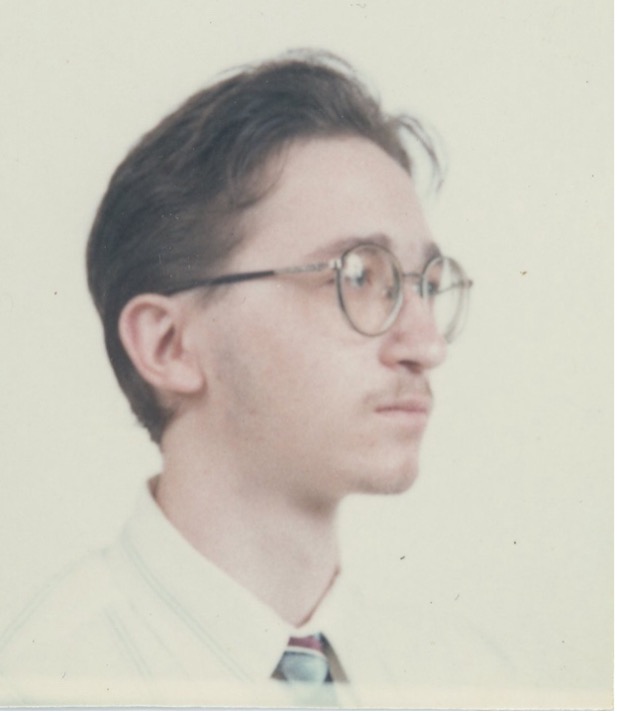
It took four more trips to OVIR, a few boxes of liquor-filled chocolate candy, and about 20 hours of visiting different bureaucrats, waiting in bleak institutional corridors covered in peeling pale green paint for yet another paper to be signed and stamped. Even my homeroom teacher had to write a recommendation letter for me – without it I wasn’t allowed to apply for an exit visa. Three days before I was scheduled to leave for the embassy in Moscow, I got the coveted international passport, with a stamp that for all intents and purposes indicated that the Belorussian government gave me permission to leave the country.
Getting a passport wasn’t enough – I needed money. To pay for the airfare from Moscow to Norfolk, we took a loan from HIAS – a non-profit humanitarian Jewish organization that helps refugees and asylum seekers around the world. I was well-aware of the fact that I was moving to a different country, a country whose language I did not speak and where I did not possess immediately employable skills. Furthermore, I was painfully aware that I was moving across the ocean with a handicapped father who was unable to work, and an elderly grandmother who was getting more and more erratic every day. I needed money.
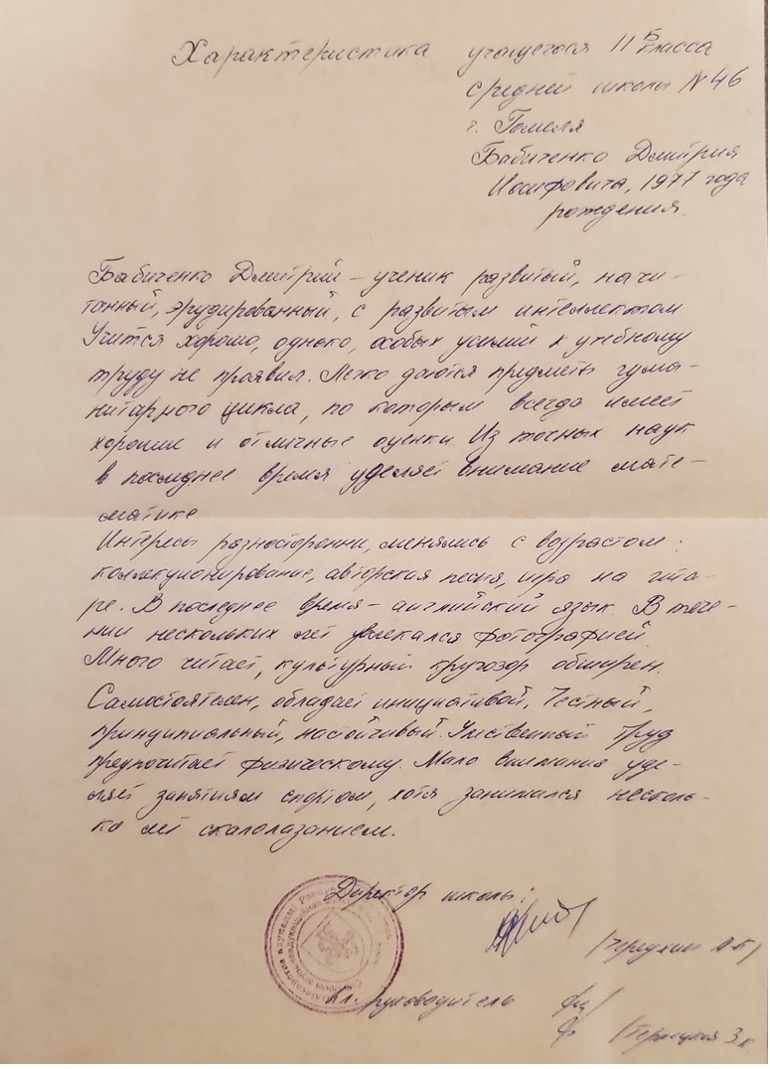
OVIR passport application.
1993.
Babichenko Dmitriy is a good student, well-read, with a developed intellect. He is a good student, however, does not work very hard at his studies. Humanities subjects come easy to him, and he always gets good and excellent grades. Lately, he has been putting a lot of effort into improving mathematics.
Has very broad interests that change with age. His interests have included collecting, singing, and playing guitar. Lately, he has also been learning English. For several years, he was very interested in photography. Reads a lot, and has a well-rounded worldview.
Self-sufficient, always takes initiative. Honest, very principled, persistent. Prefers mental tasks to physical ones. Doesn’t spend time on sports, although he dedicated several years to rock climbing.
In February of 1994 Belarus was in a state of a terrible economic downturn. The currency adopted by the Belorussian government after Belarus seceded from the Soviet Union wasn’t worth the paper that it was printed on. As a matter of fact, Belorussian currency frequently ended up being a toy for young children. While most countries print faces of presidents, royalty, or dictators on their bills, Belarus chose images of indigenous fauna. Belorussian rubbles were adorned with pictures of squirrels, bunnies, wolves, lynx, and bears, and there were numerous stories about children mistaking money for cutting patterns and taking scissors to the rubbles to cut out cute animal silhouettes. When the new Belorussian rubbles were introduced in 1992, my sister found the money that I was saving for a new camera and cut out the animals to make a card for our mom.
As the economy had gotten worse and the inflation ran unchecked, many people turned to the flea market economy to supplement their meager earnings. Thousands of people flocked to Poland, Lithuania, the Czech Republic, and Bulgaria to buy cheap goods and to resell them at Belorussian flea markets. Those who could not afford to travel abroad, or those who did not have a travel passport were forced to sell whatever they could – musical instruments, furniture, dishes – anything that had any value (and completely worthless things) could be found in massive open-air flea markets in every Belorussian town.
I did not have too many things to sell – the only things that I owned that were of any value were books, cameras, and my postage stamp collection. Books were difficult to sell – at the time when everything is falling apart around you, reading is not a huge priority. While philately was still quite popular and there was even a special flea market dedicated to collectibles, I wasn’t willing to part with my stamp collection. As a matter of fact, I still have every single stamp I have collected in my lifetime! The only thing left to sell, things that had some value, were my cameras. By 1993 I had firmly decided that I wanted to make a career as a photojournalist, and I would spend every ruble on camera equipment and film. I had three cameras – an old Smena 8, a Zenit ET, and a FED 5B. I wasn’t willing to part with the Smena or the Zenit – the Smena was my first camera, and the Zenit traveled with me all over the Soviet Union. The FED, however, was my backup camera and I did not have any emotional attachment to it. Moreover, the name of the camera has always given me the creeps. FED is an acronym for Felix Edmundovich Dzerzhynskiy, the father of the first two Soviet secret police organizations, the Cheka and the OGPU, and one of the chief architects of the Red Terror. As I said, the name gave me the creeps.
I cleaned the camera and the lenses, packed everything into a camera bag, and went to a flea market to see if I could make some money that would get me started in the United States.
Selling in Soviet and post-Soviet markets has always carried a stigma with it. For decades, free enterprise in the Soviet Union was illegal, and people who could get their hands on marketable goods and who could sell those goods were looked down upon as profiteers and speculators, basically leeches on Soviet society’s skin. That mentality has been embedded in almost every Soviet citizen’s brain – selling things for profit is a shameful activity. As I wandered through Gomel’s central market, looking for a spot to set up, I kept glancing around to make sure that I did not run into anyone I knew. I finally came across a row of people selling various electronics off makeshift tables and blankets spread on the cracked asphalt. I set my camera bag on the ground, hung the FED around my neck, and held up a sign that read “A camera for sale.”
Most people walked past me without a second glance. In 1994, when most people’s purchasing priorities revolved around food and clothing, not too many were interested in an old Soviet-made rangefinder camera. I stood in that spot for hours. The market was filled with sellers and potential buyers; every square centimeter of the ground was covered with benches, tables, boxes, crates, and blankets, and people selling everything from Ukrainian watermelons to Sony tape players to refrigerator parts. I could not even go to the restroom – leaving even for a moment would mean that someone else would pounce on my spot.
After about three or four hours, my resolve began to wane, and I decided to wrap things up and go home. I put my camera in the camera bag and started walking toward the market’s gate. As I was about to exit, someone grabbed my shoulder and tapped the paper “A camera for sale” sign that I was still carrying in my hand. “Do you still have the camera?” – asked a woman with a very heavy accent. I turned around to see a tiny Vietnamese woman with two old cameras already around her neck. “Yes, I still have the camera.” I set the bag on the ground, opened it, and handed the FED to the lady. She deftly opened the camera’s bottom plate, flicked the film advance lever, listened to the shutter at different speeds, and eventually nodded. “How much?” – she asked. I don’t remember the actual Belorussian rubble amount, but when I exchanged the money into US dollars, it came out to about $25.00.
That was my starting capital.
[1] Dedovshchina (Russian: дедовщина, lit. rule of grandfathers) is the ubiquitous informal practice of hazing and abuse of junior conscripts in the Soviet Army by more senior conscripts, soldiers, and officers.
 Dmitriy B.
You must be logged in to post a comment.