I found out that I was Jewish two days after my twelfth birthday, a discovery that was shortly followed by a punch in the face and a bloody nose.
When I was growing up, the Soviet school system had 10 grades. Students in each grade year were subdivided into four cohorts, or classes – A, B, C, and D. Each group had a journal – a large vinyl-bound book that teachers used to record students’ grades. Every week one student from each class was assigned the responsibility to carry the journal from classroom to classroom and hand it to every teacher. The first page of this journal contained a list of all students in each group, including their parents’ names and home addresses. Another column listed each student’s nationality.
Nationality has always been an interesting concept in the Soviet Union. The USSR consisted of 15 core republics and more than 100 distinct ethnic groups. The Soviet constitution promised equal rights to all citizens, regardless of their nationalities and religious practices; in reality, things were much more along the lines of “all animals are equal, but some are more equal than others.” On June 24 of 1945, Stalin addressed the nation with a speech about the heroic actions of the Red Army during the Great Patriotic War. In that speech, the great leader spoke about the “love and respect of all nations of the Soviet motherland to their older brother – the Russian people.” Ethnic Russians were the older brothers, closely followed by their Ukrainian and Belorussian siblings. The rest of the nationalities had somewhat of a lesser status, especially when it came to getting into good universities or getting jobs in major Soviet cities.
If the Georgians, Armenians, Kazakhs, Latvians, and Estonians were considered “younger brothers”, the Jews were at best the equivalents of the proverbial red-headed stepchildren. There was a semi-official quota on how many Jews could be accepted to universities or hired for certain jobs. My mother, for example, could not get into a university until my grandfather bribed an official at a passport agency. With one flick of a pen, my mother’s nationality was changed to “Russian” and she magically passed all admission requirements.
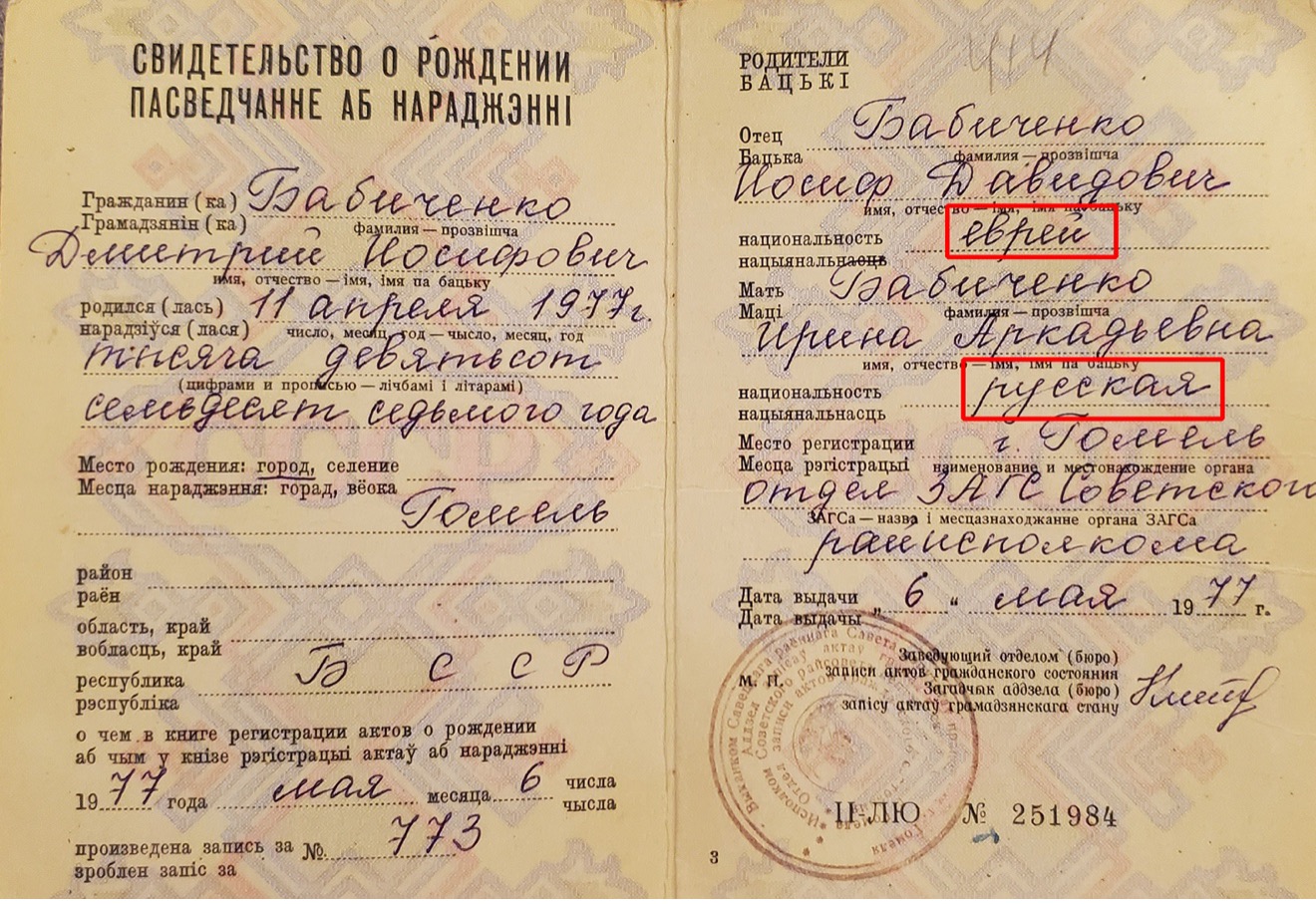
I was happily ignorant of my nationality until one of the kids in my grade decided to flip through the class journal. “Hey everybody, did you know that Dima is a Jew?” – he announced to the whole class. Everyone turned to look at me. “Are you really a Zhyd?” – someone asked me. “I don’t think so!” – I answered. – “My mother is Russian.”
At that point, no one was listening to me. “You are a freaking Zhyd” – exclaimed the kid with a journal.
“I am not” – I jumped out from behind my desk and rushed the kid. Unfortunately for me, I was the smallest kid in my class; the next thing I knew I was on the floor, crying.
I ran out of the classroom, leaving all of my things behind. At the time, I lived with my grandparents and their apartment was within a 10-minute walk from my school. I ran home through the snow, in my school uniform and my indoor shoes. I burst into my grandparent’s apartment crying and yelling, “Tell me, tell me now, am I a Jew? Kids at school told me that I’m a Zhyd and beat me up. Am I a Zhyd?”
My grandparents looked at each other. I didn’t know which was worse – the expression of fury on my grandfather’s face, or the complete helplessness of my grandmother. They sent me to the bathroom to wash my face; I could hear them arguing in the kitchen.
When my grandparents argued, they always switched to Yiddish. Of course, I did not know that they spoke Yiddish. They told me it was German – supposedly my grandmother learned it in school, and my grandfather learned it when he was a POW in a German labor camp during the war. In my family, no one has ever discussed their past. Growing up, I vaguely knew that my grandmother was born in Chernobyl, my grandfather in Grodno, and my mom in Vorkuta, but that was the extent of my knowledge of our family history. We never talked about religion or politics, words like nationality or, got forbid, Judaism, were never mentioned in any conversations. In the Soviet Union, religion was a taboo. Karl Marx’s dictum “Religion is the opium of the people” has been used to justify the destruction of thousands of churches, synagogues, and mosques across the USSR since the 1920s. In schools, we learned about the evils of religion, the Spanish Inquisition, the Crusades, the burning of Giordano Bruno, and the perpetual wars between Catholics and Protestants.
As much time as we spent learning about the Great Patriotic War, we never learned about the Holocaust, about Nazi policies that dehumanized Jews and other “inferior” races, and about concentration camps. Jews did not exist as a nationality, because Stalin believed that in order to be considered a nationality, a group of people had to be associated with a geographical area. Since Jews have been in the diaspora for over 2000 years and did have a recent historical homeland, they were a nationality on paper only – a label in the passport designed to limit one’s success in life.
It was only in my teens that I found out that Jews had a history, a religion, and a culture that was preserved at a terrible cost across many millennia. It was in my 20s that I learned that much of my grandfather’s family perished in the Grodno ghetto during the early days of the war, that his younger sister was shot in the street by a Nazi officer. That my grandmother’s family had to hide in the woods as the German army invaded Chernobyl, that they had to hide the fact that they were Jews to escape and to be evacuated from occupied Ukraine. At 12, however, being called a Jew (or rather a Zhyd) was the worst insult I could have possibly imagined.
 Dmitriy B.
You must be logged in to post a comment.